
Why Safety Switches Matter in Every Home
Most people assume their home can’t shock them because the breakers will trip if something goes wrong. That assumption is dangerous. Unless every power and light circuit has a working safety switch, a faulty appliance can still send lethal current through you.
What a safety switch actually does
A safety switch is called a residual current device, or RCD, on switchboards and product boxes. The two terms mean the same thing. It monitors the balance of current in the active and neutral wires. In a healthy circuit, those two currents match. When current leaks to earth through a person or a damaged appliance, that balance changes.
It reacts quickly. A standard 30mA unit trips in 10 to 40 milliseconds once it senses that imbalance. Speed matters because even a small shock across the chest can disrupt the heart rhythm. Just 30mA through the heart can trigger ventricular fibrillation, where the heart quivers instead of pumping. That is why electricians regard a working 30mA safety switch as essential protection against a potentially fatal shock.
The sensor inside is simple. Both the active and neutral pass through a small magnetic ring, and their fields cancel when the currents match. Any difference means some current has found another path to earth, perhaps through you. The trip coil releases and springs pull the contacts apart. It does not need an earth wire to detect the imbalance, which is why it can still provide protection on old circuits with poor earthing.
We often hear that wiring faults are rare. They aren’t. Moisture, heat, pests and age gradually wear insulation down. Residual current devices can prevent up to 90 per cent of electrical shock fatalities (Electrical Safety Foundation International). That figure alone is a good reason to take their condition seriously.
Why a circuit breaker won’t save you
People mix up breakers and safety switches all the time because they look similar in the switchboard. Their jobs are quite different. A circuit breaker guards the wiring against overload and short circuit. It trips when too much current tries to pass through cables that could otherwise overheat.
That protects the building from heat damage and fire, but it does not provide the same protection against electric shock. You can experience a deadly earth fault while the breaker remains on because the total current has not reached its trip level. Breakers protect wires, safety switches protect people. Electricians put it that bluntly because confusing the two can have fatal consequences.
A safety switch covers that gap. Rather than responding to overload, it responds to leakage. If 30mA goes missing to earth, it cuts the power. That’s the key difference.
Think of it this way. The breaker asks how much current is flowing. The safety switch asks where the current went.
Old wire fuses work like breakers, although they respond more slowly. A thin wire melts when the current climbs too high, helping to prevent cables from overheating and causing fires. It offers no help during an earth fault that is large enough to kill but too small to melt the fuse wire. Many Perth switchboards still pair those fuses with no RCDs, leaving people exposed even though the wiring appears protected.
Why many older Perth homes still miss out
Perth has many homes built before safety switches were required on every circuit. The wiring rules known as AS/NZS 3000 began requiring RCD protection in stages from 1991 onwards. Homes wired before then often have no RCDs at all, and some still rely on ceramic fuses or rewireable wire fuses. Those fuses can stop a dead short, but they won’t stop someone from receiving an electric shock.
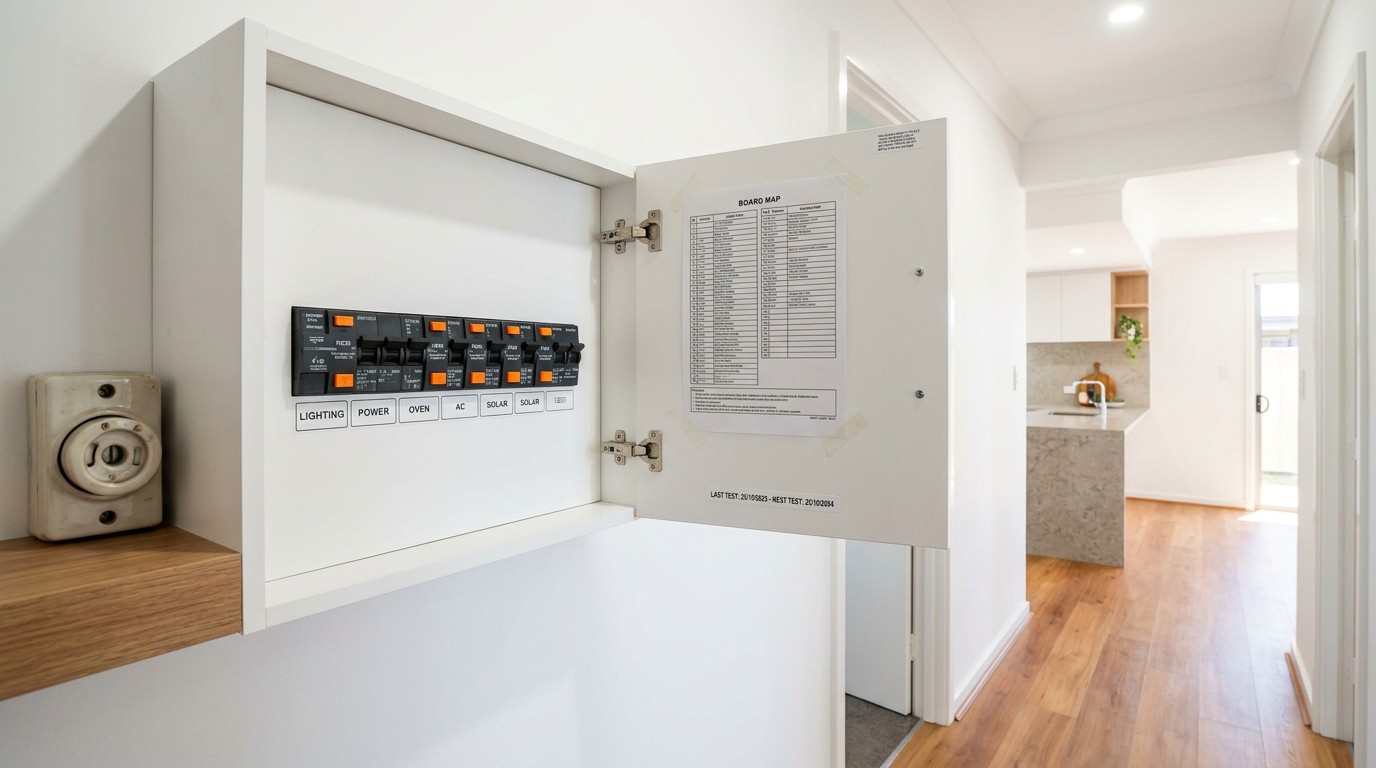
You can learn a lot from a quick look at your switchboard. If you see white ceramic holders or thin fuse wire instead of black flip switches with test buttons, you probably have no shock protection on those circuits. Some boards have one RCD for the whole home. That’s better than none, although it still does not provide complete coverage.
Renters and buyers in Perth often see this in brick homes from the 70s and 80s. A renovated kitchen does not necessarily mean the electrical protection has also been upgraded.
Don’t remove covers to inspect the board more closely. Live parts sit directly behind that panel. Read only the labels visible on the front. Modern boards mark each RCD with ratings such as 30mA and include a test note. If you see only amp ratings and no test note, that circuit may not have shock protection.
What an upgrade looks like in a real home
A switchboard upgrade replaces old fuses with modern breakers paired with RCDs. The work takes a few hours in most homes. Homeowners generally begin by getting quotes for Safety Switches Perth and booking a fully licensed electrician to inspect the board and test each circuit. The inspection will show how many circuits need protection and whether the existing board can accommodate the required units.
An electrician will remove the old fuse carriers and install combination units that place breaker and RCD protection in one module. Power points and lights are then placed on separate protected circuits. The cost stays modest per circuit when the enclosure and mains remain sound. If the board is cracked or too small, a new enclosure is also required. Electricians also allow time for fault finding because old joints and damp sheds can reveal problems once modern protection is installed.
WA law is strict on this work. Only a licensed electrician can install or replace a safety switch. DIY electrical work is illegal, and it can affect home insurance if something goes wrong.
How to test yours in under a minute
Every safety switch has a small test button marked T. The button lets you check the basic trip function without guessing whether the unit works.
Keep your lights and appliances plugged in and switched on. Press the test button firmly, and power on that circuit should cut out immediately. Push the toggle back up to reset it. If the lights and power points come back on, the unit has passed this basic test.
Do this monthly.
If nothing happens when you press the test button, treat the unit as failed. Do not keep using that circuit on the assumption that protection still exists. Call a licensed electrician promptly and ask for a timed trip test under AS/NZS 3760.
You don’t need tools or specialist skill for this check, and it takes less than a minute. Write the date on a sticker inside the cupboard door as a reminder. Tenants can carry out the same check without touching the wiring. The test button is designed to be used while the switchboard is intact and in sound condition.
A timed test uses a meter to check the trip time. It confirms whether the unit still opens within 40 milliseconds at its rated leakage. Electricians can log the result for landlords and buyers who need written evidence.
If it keeps tripping, don’t ignore it
No one likes resetting a tripped switch in the dark, and it is tempting to assume the switch itself is faulty. In most cases, however, tripping means the unit detected current leaking where it shouldn’t.
The causes are often straightforward. A cracked kettle element can allow power to track to earth. Rain may enter an outdoor power point and bridge the contacts. A mouse can chew insulation in the roof, while a worn washing machine hose may drip onto a motor.
Unplug suspect appliances and try resetting the switch. If it holds, plug items back in one at a time until it trips again. That process can identify the likely culprit. If the switch trips with everything unplugged, leave it off and call an electrician. Never tape a switch up or replace it with a plain breaker simply to stop the inconvenience.
Perth winters often reveal this pattern with garage fridges and reticulation boxes. Damp conditions and electricity are a poor combination. In the US, the equivalent protective device is called a GFCI, and users there report similar apparent false alarms that turn out to be genuine leaks. Treat nuisance tripping as an early warning because investigating it is safer and usually cheaper than waiting for a shock.
Start by disconnecting outdoor equipment, including pool gear and garden lights, because it is exposed to weather and ants. Then check appliances on the kitchen bench. Toasters and kettles fail often, and a dark mark near a plug can provide a useful clue.
Where one switch is not enough
One RCD for an entire home was common in the 90s, and it met the rules at the time. The drawback is that one fault can cut power to everything. It can also leave blind spots if the lighting circuits were not connected to the device.
Current practice provides RCD protection for both power and lighting circuits. Shed, garage, air-conditioning and pool feeds need protection too. Damp locations and long cable runs are common places for earth faults. If current leaks from a bore pump or patio heater, its own RCD can trip without cutting power to the fridge. Separating circuits limits the disruption while the fault is investigated.
Lighting circuits are among those we most often see left unprotected. People assume lights cannot shock them, but contact can occur during a bulb change or when a downlight transformer fails. Protecting those circuits closes a gap that many homeowners overlook.
Ask your electrician for a board map after any upgrade. It should show which RCD protects each room or circuit. Keep it inside the switchboard door for the next test.
Renting, buying and covering the risky rooms first
WA rental rules expect landlords to provide RCD protection. The details change from time to time, so tenants should ask for written proof instead of relying on an assumption. Ask when the switchboard was last inspected, when the RCDs were installed and whether test records are available. A well-managed property should have those records on file.
Buyers should make similar checks before settlement. Look inside the switchboard cupboard during an inspection and note whether every circuit has a unit with a test button. Where possible, put electrical compliance requirements in writing as a condition of the purchase.
If a full retrofit cannot happen this month, start with the higher-risk areas. Kitchens, bathrooms, laundries and outdoor power points combine water, appliances and flexible cords. An outlet with built-in RCD protection can cover that location until the switchboard work is completed. Your electrician can advise which circuit should be prioritised.
Insurers also consider the condition of household wiring. A home with exposed fuse wire and no test records can be harder to defend after a claim. Keep invoices for switchboard work with your policy documents, along with clear photos of the new board and its labels.
Keep the switchboard clear and properly labelled. Don’t stack paint tins or other items against it because quick access matters when a circuit trips. If the property agent cannot provide test records, arrange an independent test. It costs relatively little and gives you a clear answer.
Look at your switchboard tonight, press the test button and see what happens. Working safety switches in Perth homes sit quietly in the background until a fault occurs. That sixty-second check is a simple way to confirm that an important layer of electrical protection is ready to respond.



Leave a Reply