
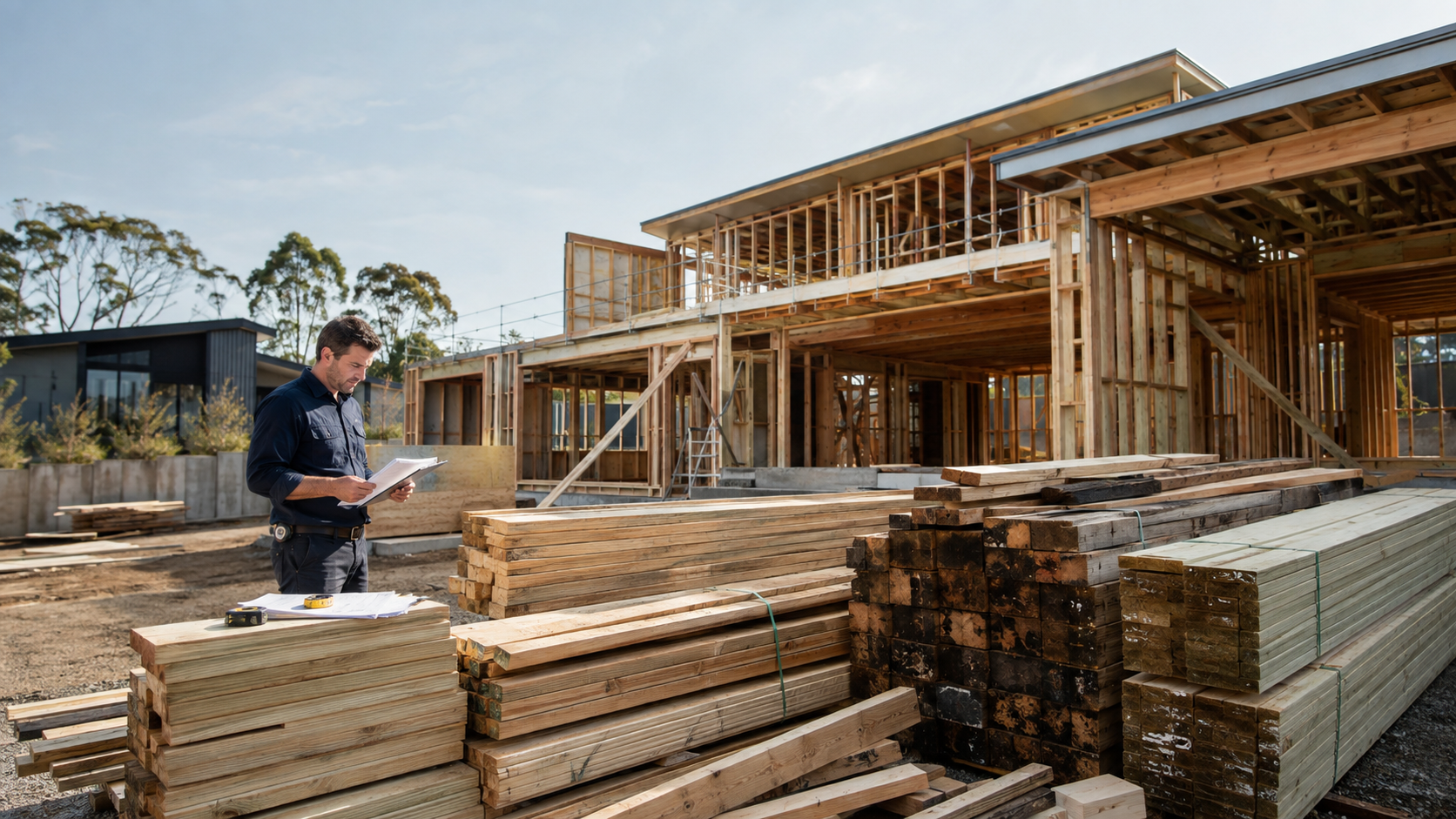
8 Common Timber Sourcing Mistakes That Can Ruin a Custom Home Build
The vast majority of expensive custom homes that go over budget or fail a framing inspection don’t need a redesign. They need you to order different timber. These aren’t obscure technical failures. They’re the same five mistakes, repeated by first-time renovators and owner-builders every year.
Mistake 1: Choosing timber by look and price instead of structural grade
When framing fails site inspection, it’s often because the wrong timber grade was used to save on cost. The difference between passing and failing often comes down to the tensile strength in bending of the timber that’s been ordered and used as lintels or bearers – the spans stressed by weight. This is what’s known as the timber’s F-grade. Most straight framing timber is what’s known as ‘unseasoned’, F5 or F7 (some hardwoods go as high as F14, a number that denotes bending stress in megapascals). F-grades are also specified in AS 1720.2 Timber structures, the Commercial and Industrial Building Code. LVLs have an F-grade and an engineered floor joist spec might be F11 or F14, like some hardwoods – but not all of them. Something like a timber pile will often have a level of hazard treatment specified which is what its H-grade indicates.
A bit like weld strength is different from thickness in steel, they do different jobs and misusing either gets a building site shut down pretty quickly. Painfully, it’s often not noticed until the plaster’s up.
Mistake 2: Ordering unseasoned or green timber for interior work
Wood absorbs and releases moisture depending on its environment, and that process continues once it’s in your project. Green or unseasoned timber has high moisture content when you order it – sometimes over 25% water for the tree it was milled from – and as it dries to equilibrium moisture content inside the completed house, it shrinks. Not a bit. Enough to pop nails, crack plasterboard, cup floorboards, and warp door frames within the first summer of occupancy.
Kiln-dried timber has already been brought down to a stable moisture content, often to within 10-15%, which is close to what it will reach inside a conditioned building. It also costs the seller in terms of the energy used to run the kiln. It costs you a bit more to buy. It costs a lot of time and expense to replaster, renail, and rehang doors. Guess which yields the best return on investment? The same goes for any sheet materials made of or coated with timber, including I-joists, and anything fitted within millimeter tolerances that’s expected to open and shut freely for the foreseeable future.
When you are in the act of ordering something, ask the seller for moisture content details on the batch. A decent supplier will have an idea, and it’ll be a good one, which can also help you decide who to buy from if you have competing quotes. If they can’t tell you, they know less than they should about the product they’re pushing.
Mistake 3: Treating all treated timber as equivalent
H3, H4, H5 are not some sort of secret squirrel code, they are hazard classes defined under Australian Standard AS 1604, and each one tells you where treated timber is safe to use based on its exposure to moisture, ground contact, and biological attack. H3 is rated for above-ground outdoor use – that’s out in the weather but above the ground or water where the timber can dry in the sun. Think exposed framing, pergolas, fascia boards, external cladding. H4 is for in-ground contact like fence posts and stumps. H5 is for higher-risk ground contact or freshwater exposure. Using H3 timber in a post that sits in or near soil isn’t a minor shortcut. You’re opening the front door and brazenly inviting in the termites.
CSIRO research estimates that termites cause more damage to Australian homes each year than fire, storms, and floods combined, costing homeowners over $1 billion annually. The majority of damage caused by termites starts right at the junction between the untreated or under-treated timber and the soil or moisture. The Perth coastal environment adds another layer. Proximity to the coast accelerates both moisture ingress and biological attack, so the hazard class that works fine for a shed 40 kilometres inland won’t give the same service life for a deck two streets from the water. Matching the right hazard class to the right application is non-negotiable, and it’s not something a checkout counter conversation will resolve.
Mistake 4: Assuming a hardware store can spec your project
Big-box hardware stores have their purpose. Need touch-up paint, rivets, or a 9/16th socket elbow? Head on in. Planning a sappy DIY weekend with your eldest? Go to the mega-store. They’re there and they’re convenient. Not where you want to source your timber for a new deck or a second-story extension though.
Batch grading certificates which allow traces of your timber down to the specific length are something specialist yards provide. Hardware stores don’t provide them. Not because they’re lazy, but because they’re not set up for it. Moisture meter readings should be available by batch because they can vary by the amount that deteriorates your joinery. When it comes to Timber Supplies in Perth, working with a yard that understands local conditions – coastal exposure zones, species availability, treatment requirements for the climate – means you’re getting advice that’s calibrated to your actual project, not a generic sales transaction. Spotted Gum and Jarrah are two different timber varieties with different hardness ratings, movement characteristics, and durability profiles. A yard that works regularly with builders in your region will also know which species are available in what lengths, and how far out you need to order for anything outside standard stock.
Hardware store staff aren’t incompetent. They’re not specialists. The difference shows up when the timber arrives on site.
Mistake 5: Getting the quantity wrong before you order
There are two ways to get quantity wrong: under-order and order too early. Both cost you. Both hold things up.
Under-order is the more common cliff to fall off. First-time renovators! They calculate linear meters from a plan, and that’s exactly what they order. They don’t allow for lap joints. Or corners (where both pieces of timber are not seen in their entirety and so can both be shorter). Or the offcuts that get trimmed to fit a specific opening. Or the waste that the timberyard cuts into every piece so they can work to the nearest metre. The newbies have to come to grips with a new term: the waste factor. It’s standard for a reason. Renovations demand 5-10% waste over and above your best guess at the requirement. Ignore it and your phone call two weeks into the build will be, “Is it possible to hold a matching batch?”
Ordering too early is a different problem. Your supplier warns that lead times are six weeks so you place an order before your engineer has locked in the very precise specs required. Those pre-engineering guesses of the lengths, grades, and species of the timber you think you need make the order wrong before it’s right.
The right order: Engineer first. Get final structural drawings. Then order only when the cut list has been provided by your builder or truss manufacturer.
Mistake 6: Ignoring nominal versus actual dimensions
A “4×2” is not 4 inches by 2 inches. In reality, it’s 90x45mm. That space between what the name implies and what you really get trips up first-time renovators at the most inconvenient times – when they are cutting joinery, framing window openings or designing wall thickness and the calculations don’t come out.
Nominal dimensions are the shorthand preferred by the timber trade. Actual dimensions are what you use when you’re on the tools. A wall framed with 90x45mm studs has a different thickness, finish and building profile to a wall framed with 70x35mm studs, albeit both are correctly known as “timber framing.” The difference can be found in the snugness of the insulation, the thickness of the lining board, the depth of the window reveal and also in how other trades working around you – tilers, plasterers, joinery installers – measure and cut their work.
Whenever you’re at the sharp end of a saw, always check you’re cutting off what you think you’re cutting off. It’s a five-minute phone call to the timber yard that wards off a fortnight of the jigsaw and sanding work.
Mistake 7: Ordering specialty stock without lead time
Framing timber that’s commonly used in standard lengths should be in stock. But unfortunately, everything else you need may take a little longer to get your hands on – meaning you could be up for a wait of up to four weeks when you run out of an item you assumed would be on the shelf.
Long items that aren’t easily broken into shorter, more manageable sizes (which instantly rules out stock at your local building-supplies place) are the most common cause of unexpected delays in construction. Long items are needed in nearly every frame, whether it’s for a floor, roof, or wall frame. When you need them – or a less common species – the special-order wait can apply.
Mistake 8: Letting good timber go bad on site
You may go to great lengths to obtain the suitable grade, the right species, the right moisture content, the right treatment class – and yet render it useless before it gets installed because of improper storage at the site.
Timber subjected to contact with the wet ground will take up moisture, whatever the weather. Timber stacked hard against other packs in the delivery will be unable to breathe and release its trapped moisture. Timber blanketed in impermeable plastic sheeting will accumulate condensation.
And this is the primary cause of the cupping, twisting, bowing, and spring that you’ll cop the blame for the first time you supply new product to a client or builder. Because it didn’t happen in their yard or on their job, yet!
Site storage is hardly brain surgery. Lay it flat on bearers in a location clear of the ground, use laths as spacers between each layer to ensure air circulation, and cover with a permeable sheet of tarp or shade cloth. If it’s fresh off the truck and destined to sit around for a week or so, recheck the moisture content prior to installing it in the work.
The questions to ask before you order
Each of those mistakes has a question that would’ve prevented it. What grade does the engineer’s spec require? Is this batch kiln-dried, and what’s the moisture content? What hazard class does this application require? What are the exact dimensions? Which items will have to be special-ordered, and what’s the lead time? What waste factor does your cut list assume?
None of those are arcane. Pros just automatically pose them because they’ve encountered the consequences of getting the wrong answer thrown back in their faces. First-time remodelers don’t think to ask them because they don’t know they should. The point of making a preliminary call to the appropriate pro before you order is to get those questions answered before the saw starts whirring, rather than after.




Leave a Reply